Income Tax Rates, Surcharge and Cess for Every Type of Taxpayer
Income Tax - FY 2025-26
By Nikhil Pathak — Semi Qualified CA · 2026-06-24 · 16 min read
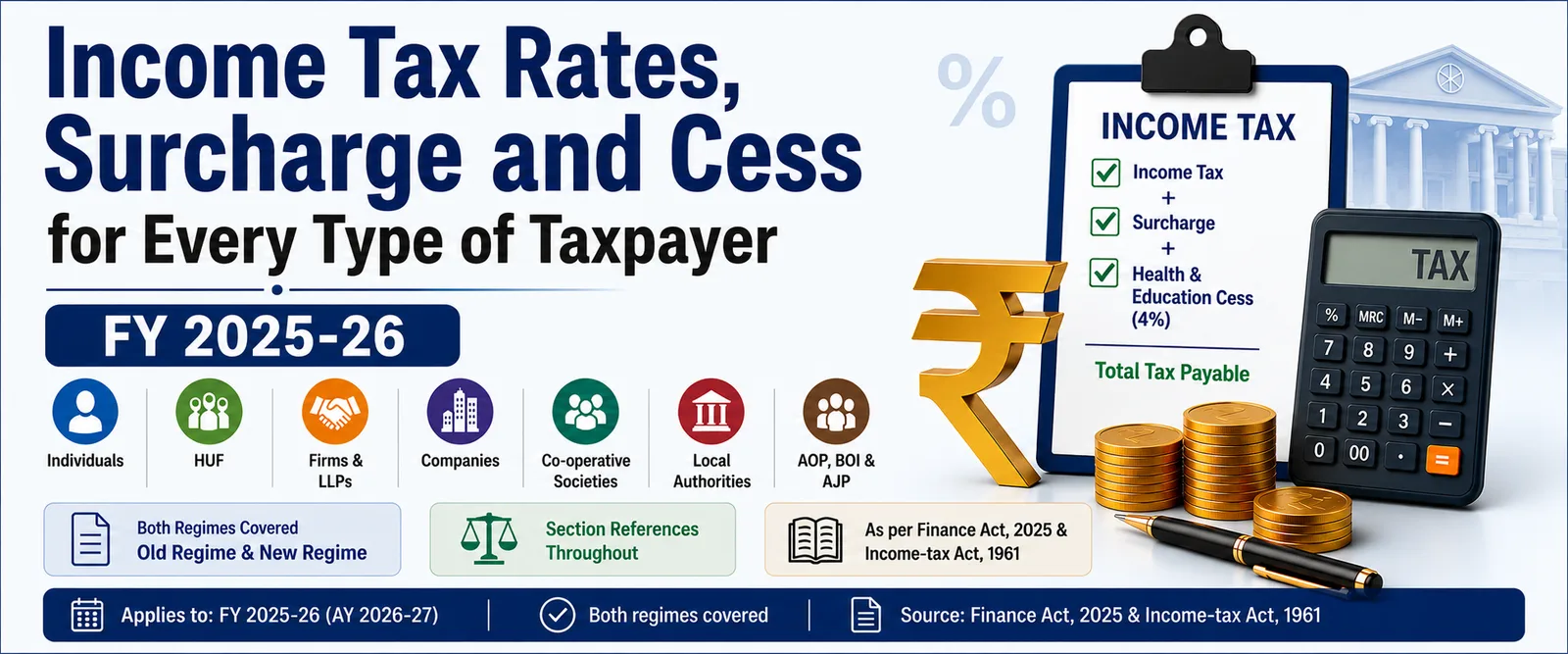
Your slab rate is not your effective tax rate. By the time surcharge and cess run their course, a 30 percent slab produces at least 31.2 percent in real liability. This post covers all the rates for FY 2025-26: every taxpayer category, both regimes, section references throughout.
Applies to: FY 2025-26 (AY 2026-27)
Both regimes covered
Source: Finance Act, 2025 & Income-tax Act, 1961
Most people reading their tax intimation have no idea how the final number was reached. They have a rough sense of their slab rate, and then they see a number on the challan that is meaningfully larger. Between those two things, two separate charges ran their course. Each is calculated on the layer beneath it, which is why the order matters more than most people realise.
For FY 2025-26, the rates cover individuals, Hindu Undivided Families, firms and LLPs, companies, co-operative societies, local authorities, associations of persons and bodies of individuals. All of them are here, with the section and sub-section references next to each rate.
1)The three layers of every tax bill
The Finance Act, 2025 charges income tax at the rates in the First Schedule, then adds surcharge, then adds the Health and Education Cess on top of both. Finance Act 2025, s. 2(1) s. 2(11) & 2(12)
Each layer is calculated on the running total of the layers below it. Find your base tax from the slab or flat rate first. Then add surcharge as a percentage of that base tax alone, not of your income. Then add 4 percent cess on the combined total of base tax and surcharge. Change the order and you arrive at a wrong number.
For Example
Under Old regime - Taxable Income Rs. 1,20,00,000
Layer | Amount |
|---|---|
Base tax on Rs. 1,20,00,000 | Rs. 34,12,500 |
Surcharge at 15% on base tax (income above Rs. 1 crore) | Rs. 5,11,875 |
Subtotal (base + surcharge) | Rs. 39,24,375 |
Cess at 4% on subtotal | Rs. 1,56,975 |
Total tax payable | Rs. 40,81,350 |
Surcharge is 15 percent of the base tax, Rs. 34.12 lakh. Not 15 percent of the income. Cess is 4 percent of the Rs. 39.24 lakh subtotal. The sequence is fixed, and it produces a predictable number every time you follow it.
2) Individuals, HUF, AOP, BOI and artificial juridical persons
This is the one place in the tax law where you get a genuine choice. Since FY 2023-24 the new regime is the default. You are placed in it automatically and pay the new-regime rates unless you opt for the old regime before filing. The old regime is still fully available; it is just no longer where you start.
s. 115BAC(1A), new regime default First Schedule, Part III, Para A, old regime
New regime slabs (the default)
The Finance Act, 2025 widened these slabs, moving the entry point to Rs. 4 lakh and pushing the top rate further up, to Rs. 24 lakh. The new regime has no age-based slab variation. A person aged 25 and a person aged 75 use the same table.
New regime
For Individual, HUF, AOP, BOI, AJP - FY 2025-26 s. 115BAC(1A)(iii)
Total income | Rate |
|---|---|
Up to Rs. 4,00,000 | Nil |
Rs. 4,00,001 to Rs. 8,00,000 | 5% |
Rs. 8,00,001 to Rs. 12,00,000 | 10% |
Rs. 12,00,001 to Rs. 16,00,000 | 15% |
Rs. 16,00,001 to Rs. 20,00,000 | 20% |
Rs. 20,00,001 to Rs. 24,00,000 | 25% |
Above Rs. 24,00,000 | 30% |
For Example - Rs. 16,00,000 income
How each slice is taxed
Income slice | Tax |
|---|---|
First Rs. 4,00,000 at nil | Rs. 0 |
Rs. 4,00,000 (4L to 8L) at 5% | Rs. 20,000 |
Rs. 4,00,000 (8L to 12L) at 10% | Rs. 40,000 |
Rs. 4,00,000 (12L to 16L) at 15% | Rs. 60,000 |
Base tax | Rs. 1,20,000 |
Cess at 4% | Rs. 4,800 |
Total tax payable | Rs. 1,24,800 |
Income is below Rs. 50 lakh so no surcharge applies. Each rate operates only on the slice of income within that band, not the total.
Old regime slabs
The old regime reverses the deal. Less favourable slabs, but most deductions and exemptions stay on the table. Three age-based tables apply: a general one, one for residents aged 60 to below 80, and one for residents aged 80 and above.
Old regime
For General (individual below 60, HUF, AOP, BOI, AJP) - FY 2025-26 Part III, Para A(I)
Total income | Rate |
|---|---|
Up to Rs. 2,50,000 | Nil |
Rs. 2,50,001 to Rs. 5,00,000 | 5% |
Rs. 5,00,001 to Rs. 10,00,000 | 20% |
Above Rs. 10,00,000 | 30% |
Old regime
For Resident senior citizen, aged 60 to below 80 - FY 2025-26 Part III, Para A(II)
Total income | Rate |
|---|---|
Up to Rs. 3,00,000 | Nil |
Rs. 3,00,001 to Rs. 5,00,000 | 5% |
Rs. 5,00,001 to Rs. 10,00,000 | 20% |
Above Rs. 10,00,000 | 30% |
Old regime
Resident Super Senior Citizen, aged 80 and above - FY 2025-26 Part III, Para A(III)
Total income | Rate |
|---|---|
Up to Rs. 5,00,000 | Nil |
Rs. 5,00,001 to Rs. 10,00,000 | 20% |
Above Rs. 10,00,000 | 30% |
For Example - Old regime - Rs. 16,00,000 income, age below 60
How each slice is taxed
Income slice | Tax |
|---|---|
First Rs. 2,50,000 at nil | Rs. 0 |
Rs. 2,50,000 (2.5L to 5L) at 5% | Rs. 12,500 |
Rs. 5,00,000 (5L to 10L) at 20% | Rs. 1,00,000 |
Rs. 6,00,000 (10L to 16L) at 30% | Rs. 1,80,000 |
Base tax | Rs. 2,92,500 |
Cess at 4% | Rs. 11,700 |
Total tax payable | Rs. 3,04,200 |
On the same Rs. 16 lakh, old regime costs Rs. 3,04,200 against new regime's Rs. 1,24,800. That gap is real, but it assumes zero deductions on the old-regime side. If this person claims Rs. 3 lakh through 80C, HRA and a home loan, their old-regime taxable income falls and the two regimes move closer. The regime question has a definitive answer only once you account for deductions you can legitimately claim.
3)What you give up in the new regime
Getting lower slabs in the new regime means surrendering most of the deductions people have built their tax planning around. This is what determines which regime costs less for you, so the section numbers matter. The law lists them all in one sub-section. s. 115BAC(2)(i)
Not available under the new regime
Deductions and exemptions switched off
Section | What it is |
|---|---|
s. 10(5) | Leave Travel Concession (LTC) |
s. 10(13A) | House Rent Allowance (HRA) |
s. 10(14) | Most special allowances, including children's education and hostel allowance, other than a few the CBDT has specifically notified |
s. 10(32) | Exemption on a minor child's clubbed income |
s. 10AA | Exemption for units in a Special Economic Zone |
s. 16(ii) | Entertainment allowance |
s. 16(iii) | Professional tax paid |
s. 24(b) | Interest on a home loan for a self-occupied property |
s. 32(1)(iia) | Additional depreciation |
s. 35AD | Capital expenditure on a specified business |
s. 80C | Life insurance premiums, PPF, ELSS, EPF contributions, home loan principal repayment and similar |
s. 80D | Health insurance premiums |
s. 80E | Interest on an education loan |
s. 80G | Donations to approved funds and charitable institutions |
s. 80TTA / 80TTB | Interest on savings accounts and fixed deposits |
Chapter VI-A | The remaining Chapter VI-A deductions, except the three listed below |
You also lose the right to set off a house property loss against other income, and losses or depreciation attributable to any of the deductions above cannot be carried forward either.
What survives in the new regime
Three deductions carry over, and for salaried people the standard deduction is now Rs. 75,000.
Standard deduction of Rs. 75,000 on salaried income, plus the deduction on family pension s. 16(ia)
Employer's NPS contribution deducted from salary s. 80CCD(2)
Agniveer Corpus Fund contribution s. 80CCH(2)
Additional employee cost for eligible businesses s. 80JJAA
4) The Section 87A rebate, and why Rs. 12 lakh can mean zero tax
Slabs alone do not settle what you pay at lower incomes. The Section 87A rebate can wipe the liability out entirely below a threshold. It works differently in each regime. s. 87A amended by Finance Act 2025, w.e.f. 1-4-2026
Section 87A rebate for a resident individual - FY 2025-26
Regime | Rebate available if total income is | Maximum rebate |
|---|---|---|
New regime | up to Rs. 12,00,000 | Rs. 60,000 |
Old regime | up to Rs. 5,00,000 | Rs. 12,500 |
At Rs. 12 lakh, the new-regime base tax works out to exactly Rs. 60,000. The rebate is the lower of Rs. 60,000 or the actual tax. So it cancels the entire liability and you pay nothing. The slab generates Rs. 60,000 of tax; the rebate removes it. That is the mechanism, and it is why the zero-tax headline is accurate without being misleading.
The Rs. 12.75 lakh salaried threshold
The standard deduction of Rs. 75,000 reduces gross salary before the slab applies. A salaried individual earning Rs. 12.75 lakh gross lands at Rs. 12 lakh taxable, hits the rebate limit exactly, and pays nothing. The deduction is doing half the work here.
Cross Rs. 12 lakh by even a rupee and the rebate is gone. Without marginal relief, that one rupee would suddenly expose over Rs. 60,000 of tax. The law prevents this by capping tax at the amount by which income exceeds Rs. 12 lakh.
For Example - New regime - Marginal Relief, Rs. 12,10,000
Marginal relief caps the damage
Step | Amount |
|---|---|
Base tax on Rs. 12,10,000 | Rs. 61,500 |
Rebate: not available, income above Rs. 12,00,000 | Rs. 0 |
Income above the threshold | Rs. 10,000 |
Tax capped at the excess (marginal relief) | Rs. 10,000 |
Cess at 4% | Rs. 400 |
Total tax payable | Rs. 10,400 |
Rs. 10,000 of extra income costs Rs. 10,400 in tax rather than Rs. 64,000. As income keeps rising past the marginal relief band, normal slab tax takes over.
One boundary on the new-regime rebate worth knowing: it does not shelter income taxed at special rates. Capital gains under sections 111A, 112 and 112A sit outside the rebate's reach. The Rs. 60,000 cap only applies to ordinary slab-rate income.
5) Surcharge: the layer that climbs with income
Surcharge is a percentage charged on the tax itself, not on income. For individuals, it kicks in at Rs. 50 lakh and rises in four steps. The two regimes diverge only at the very top.
Surcharge for individual, HUF, AOP, BOI, AJP - FY 2025-26
Finance Act 2025, s. 2 & Part III, Para A
Total income | Old regime | New regime |
|---|---|---|
Up to Rs. 50,00,000 | Nil | Nil |
Above Rs. 50 lakh to Rs. 1 crore | 10% | 10% |
Above Rs. 1 crore to Rs. 2 crore | 15% | 15% |
Above Rs. 2 crore to Rs. 5 crore | 25% | 25% |
Above Rs. 5 crore | 37% | 25% (capped) |
The 37 percent rate applies only under the old regime. Under the new regime the surcharge is capped at 25 percent regardless of how high the income goes. For very high earners, that single cap can outweigh the narrower slabs and make the new regime cheaper in absolute terms.
Two caps built into the law
Cap on dividends and capital gains. On income from dividends and capital gains under sections 111A, 112 and 112A, the surcharge never exceeds 15 percent, whatever the total income. The 25 and 37 percent rates do not touch this portion. Part III, Para A, first proviso
Marginal relief at each surcharge threshold. At Rs. 50 lakh, Rs. 1 crore, Rs. 2 crore and Rs. 5 crore, marginal relief ensures that crossing the line never costs more than the income that crossed it. Part III, Para A, third proviso
For every other class of taxpayer, the surcharge rates are lower and follow a two-band structure.
Surcharge for non-individual taxpayers - FY 2025-26
Taxpayer | Income band | Surcharge |
|---|---|---|
Co-operative society (normal rates) | Above Rs. 1 crore to Rs. 10 crore | 7% |
Above Rs. 10 crore | 12% | |
Firm / LLP | Above Rs. 1 crore | 12% |
Local authority | Above Rs. 1 crore | 12% |
Domestic company (normal rates) | Above Rs. 1 crore to Rs. 10 crore | 7% |
Above Rs. 10 crore | 12% | |
Foreign company | Above Rs. 1 crore to Rs. 10 crore | 2% |
Above Rs. 10 crore | 5% | |
Companies under s. 115BAA or 115BAB | Any income | 10% flat |
Co-op societies under s. 115BAD or 115BAE | Any income | 10% flat |
6) Health and Education Cess: the 4 percent on top
This is the simplest layer and the one nobody dodges. After base tax and surcharge are settled, a Health and Education Cess of 4 percent is charged on the combined total. It applies to every taxpayer, every regime, every income level, with no floor and no exemption. Finance Act 2025, s. 2(11) s. 2(12)
This is why a 30 percent slab rate is 31.2 percent on paper, and why the 22 percent optional company rate becomes 25.168 percent once a 10 percent surcharge and 4 percent cess are added. Both those effective rates appear again in the company section.
7) Firms and LLPs
No slabs, no regime choice. The whole of the total income is taxed at a flat 30 percent. Part III, Para C
Firm and LLP - FY 2025-26
Part III, Para C
Component | Rate |
|---|---|
Income tax on whole of total income | 30% |
Surcharge, if income above Rs. 1 crore | 12% |
Health and Education Cess | 4% |
For Example - Firm with Rs. 1,50,00,000 income
Flat rate, then surcharge, then cess
Layer | Amount |
|---|---|
Tax at 30% on Rs. 1,50,00,000 | Rs. 45,00,000 |
Surcharge at 12% on base tax (income above Rs. 1 crore) | Rs. 5,40,000 |
Subtotal | Rs. 50,40,000 |
Cess at 4% | Rs. 2,01,600 |
Total tax payable | Rs. 52,41,600 |
8) Co-operative societies
Co-operative societies can sit on normal slab rates or opt into one of two concessional flat rates, depending on when they were set up and what they do.
Normal rates
Co-operative society, normal rates - FY 2025-26
Part III, Para B
Total income | Rate |
|---|---|
Up to Rs. 10,000 | 10% |
Rs. 10,001 to Rs. 20,000 | 20% |
Above Rs. 20,000 | 30% |
Concessional rates by option
Under Section 115BAD, a resident co-operative society can opt for a flat 22 percent by foregoing specified deductions. Under Section 115BAE, a new manufacturing co-operative society can opt for 15 percent. Either option, once exercised, cannot be pulled back.
Concessional rates for co-operative societies - FY 2025-26
Section | Who it applies to | Base rate | Surcharge | Effective rate incl. cess |
|---|---|---|---|---|
s. 115BAD | Resident co-op forgoing deductions | 22% | 10% flat | 25.168% |
s. 115BAE | New manufacturing co-op | 15% | 10% flat | 17.16% |
Date condition on 115BAE
The 15 percent rate is for a co-operative society registered on or after 1 April 2023 that started manufacturing on or before 31 March 2024. Society income not from manufacturing is taxed at 22 percent within the same option. s. 115BAE(1) & (2)
9) Local authorities
Local authorities follow the same flat structure as firms, with one flat rate, one surcharge threshold, and the same 4 percent cess.
Local authority - FY 2025-26
Part III, Para D
Component | Rate |
|---|---|
Income tax on whole of total income | 30% |
Surcharge, if income above Rs. 1 crore | 12% |
Health and Education Cess | 4% |
10) Companies
Domestic companies have the most options in the rate structure. Two concessional regimes are available by choice, each with a flat surcharge of 10 percent. Foreign companies sit on a separate rate entirely.
Domestic companies, Normal rates
Domestic company, Normal rates - FY 2025-26
Part III, Para E(I)
Condition | Rate |
|---|---|
Turnover or gross receipts in FY 2022-23 up to Rs. 400 crore | 25% |
All other domestic companies | 30% |
Domestic companies, concessional regimes
Under Section 115BAA, any domestic company can opt for a flat 22 percent by giving up most deductions. Under Section 115BAB, a new manufacturing domestic company can access 15 percent. Neither option can be withdrawn once exercised.
Concessional company rates - FY 2025-26
Section | Who it applies to | Base rate | Surcharge | Effective rate incl. cess |
|---|---|---|---|---|
s. 115BAA | Any domestic company forgoing deductions | 22% | 10% flat | 25.168% |
s. 115BAB | New manufacturing domestic company | 15% | 10% flat | 17.16% |
For 115BAA: 22 percent base, plus 10 percent surcharge on that (giving 24.2 percent), plus 4 percent cess on that combined total gives 25.168 percent. For 115BAB: the same stacking on a 15 percent base gives 17.16 percent. These are the numbers that matter for planning, not the headline base rates.
Date condition on 115BAB
The 15 percent rate is for a company set up and registered on or after 1 October 2019 that commenced manufacturing on or before 31 March 2024. A company that missed the production deadline cannot enter this regime. Non-manufacturing income within the option is taxed at 22 percent; certain specified income at 30 percent. s. 115BAB(1) & (2)
Foreign companies
Company other than a domestic company - FY 2025-26
Part III, Para E(II)
Type of income | Rate |
|---|---|
General income (the balance of total income) | 35% |
Certain royalties and technical service fees under government-approved agreements made before 1 April 1976 | 50% |
A foreign company's surcharge is lower than a domestic company's: 2 percent once income crosses Rs. 1 crore and 5 percent above Rs. 10 crore. The 4 percent cess applies on top of both, as with every other taxpayer.
11) Master rate table
All taxpayer categories, base rates, top surcharge and statutory references in one place. Use this to find your row, then go to the relevant section above for the full picture on surcharge thresholds and deduction conditions.
All taxpayers
Base rates before surcharge and 4% cess - FY 2025-26 (AY 2026-27)
Taxpayer | Base rate | Top surcharge | Reference |
|---|---|---|---|
Individual / HUF / AOP / BOI / AJP, new regime | Nil to 30% (slabs from Rs. 4L) | 25% | s. 115BAC(1A)(iii) |
Individual / HUF, old regime | Nil to 30% (slabs from Rs. 2.5L) | 37% | Part III, Para A |
Firm / LLP | 30% flat | 12% | Part III, Para C |
Local authority | 30% flat | 12% | Part III, Para D |
Co-operative society, normal | 10% to 30% (slabs) | 12% | Part III, Para B |
Co-operative society, s. 115BAD | 22% flat | 10% | s. 115BAD |
Co-operative society, s. 115BAE (new mfg) | 15% flat | 10% | s. 115BAE |
Domestic company, turnover up to Rs. 400 cr (FY 22-23) | 25% flat | 12% | Part III, Para E(I) |
Domestic company, others | 30% flat | 12% | Part III, Para E(I) |
Domestic company, s. 115BAA | 22% flat | 10% | s. 115BAA |
Domestic company, s. 115BAB (new mfg) | 15% flat | 10% | s. 115BAB |
Foreign company | 35% (general) | 5% | Part III, Para E(II) |
The 4 percent Health and Education Cess runs on top of every row in this table without exception. The Section 87A rebate under s. 87A can take an individual's liability to zero up to Rs. 12 lakh under the new regime and Rs. 5 lakh under the old.
One thing worth sitting with
The regime comparison only makes sense with your actual deductions, not hypothetical ones. The gap between new and old regime on the slab alone looks large. Once you put in your real 80C headroom, your actual HRA, your home loan position, the answer usually becomes clear. Running the comparison on guessed deductions is how people end up in the wrong regime for two or three years before they notice.
Notes and sources. Rates stated are for the financial year 2025-26 (assessment year 2026-27). Figures are drawn directly from the Finance Act, 2025 and the Income-tax Act, 1961.
Primary references: Finance Act 2025, s. 2 (charge, surcharge, cess) · First Schedule, Part III, Paras A to E · s. 115BAC (individuals, new regime) · s. 87A (rebate) · s. 115BAA & 115BAB (domestic companies) · s. 115BAD & 115BAE (co-operative societies).
This article explains the law in plain terms and is not tax advice. The choice between regimes, deductions available to you, and special-rate incomes can change your actual liability. Verify your own numbers with a qualified professional before filing.